
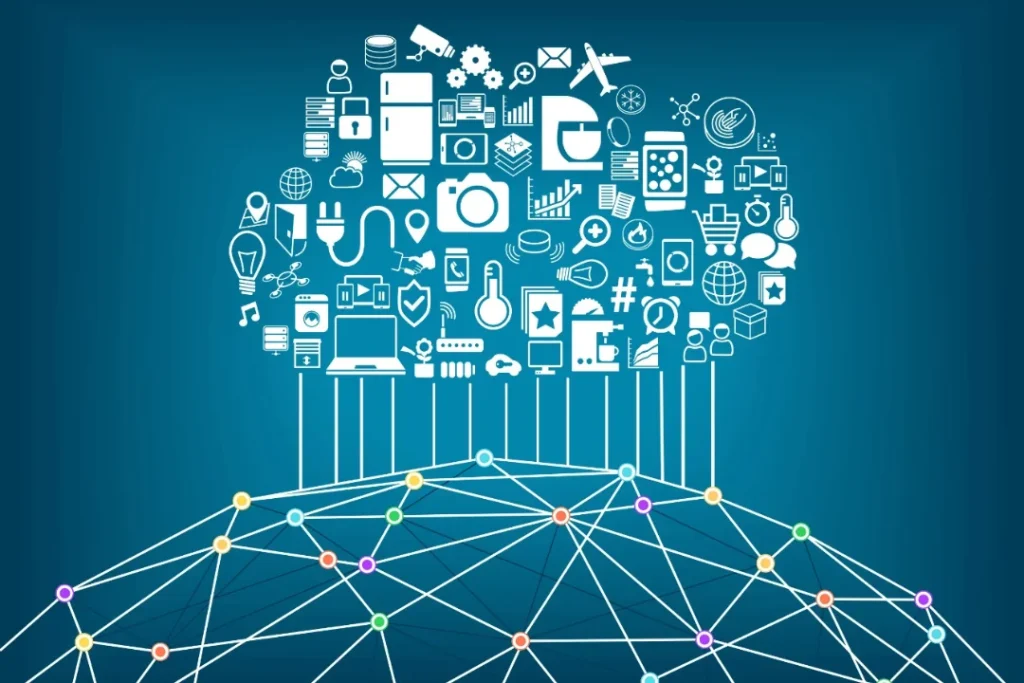
Your alarm clock wakes you up, and your coffee maker begins brewing. Traffic lights are adjusted dynamically depending on the congestion. The factory machinery schedules its own maintenance to prevent breakdowns. Such technology is not science fiction anymore. This is a reality of how interconnected machines are shaping our world in 2026.
Over 18 billion of these devices are now communicating, collecting data, and making decisions that affect everything from our morning routines to city life. They are likely to reach 40 billion by the year 2030. The difference with this transformation lies in the fact that these systems are learning, adapting, and becoming actually intelligent.
The Technology Stack Powering Today’s Connected World
There are three giant powers collaborating to produce the most massive transformation in networked technology. The market has grown to nearly 1.8 trillion dollars, and the infrastructure supporting it is undergoing a fundamental transformation.
It is true that 5G networks are here to fulfill their promise. Latency is the actual game-changer. Devices are now capable of communicating near instantly. Three milliseconds to process the conditions of the road rather than several seconds to do so are what separates safe functionality and accidents in a self-driving car. Edge computing brings the processing power closer to the data creation point. Your smart home hub no longer transmits information to a remote server and waits for instructions. It makes decisions where you need them, when you need them.
The third feature is the integration of artificial intelligence. Linked systems are not used to being automated anymore. They’re smart. They pick up the tendencies, anticipate the end results, and become better with time without human interference.
In the manufacturing sector, there are sensors to continuously check the vibration and temperature of machines. Information is immediately processed in terms of edge computing. Machine learning algorithms identify trends that are indicative of an imminent failure. The system then provides automatic maintenance scheduling, thus saving thousands of dollars in repairs and time lost in production. Firms that employed this strategy have reduced maintenance costs by 35 percent and unplanned downtimes by 60 percent.
Similar breakthroughs are being experienced in healthcare. Fitness bracelets monitor numerous health indicators. These systems combine AI analysis to identify abnormal heartbeats, prevent diabetic attacks, or alert physicians to worrying patterns before conditions worsen.
Smart Cities: Rebuilding Urban Infrastructure From the Ground Up
Wander in any large city in North America, and the infrastructure appears as it was decades ago. But at the bottom of things, something basic is shifting. Cities are putting in place networks of sensors and interconnected systems, which are fundamentally changing the way towns operate.
The annual US economy costs more than $120 billion in lost productivity and wasted fuel. Smart traffic management systems address this problem by tracking traffic in individual cities as a whole and adjusting the timing of signals in real time. In case of a big accident, there is an automatic rerouting of the traffic so that it does not cause congestion extending over miles. The travel time has reduced by 25 to 35 percent in cities that operate such systems.
Another big challenge is energy consumption. The conventional power grids are a waste of colossal energy since they are unable to check on the usage in real-time. The smart grids involve the use of linked sensors across the entire distribution network to balance demand and supply in real time. The system has the ability to cut power to nonessential systems during the time of peak usage or tap into battery reserves to avoid overloads. Optimization of this has allowed some cities to save 20 to 30 percent on their energy bills.
Connected surveillance and emergency response systems have transformed the concept of public safety. After an incident, the network’s cameras can track crime suspects through various intersections. Emergency services get instant alerts that have accurate location information. In the cities that have correctly applied such systems, the response times in case of an emergency have gotten better by 40 percent.
Cities’ efforts to meet climate targets have led to an increase in the use of environmental monitoring. The sensor networks monitor the quality of air and water and the level of pollution in the city. The system issues automatic notifications to the concerned agencies in case of exceeding safe levels.
| Smart City Application | Primary Benefit | Typical Impact |
| Intelligent Traffic Management | Reduced congestion | 25-35% less travel time |
| Smart Energy Grids | Optimized distribution | 20-30% lower costs |
| Connected Public Safety | Faster response times | 40% quicker emergency response |
| Environmental Monitoring | Data-driven decisions | 15-25% emission reduction |
Industrial Applications: The Factory Floor Gets Smart
The Industrial Internet of Things is transforming manufacturing space into a data-rich ecosystem, where all equipment presents its status, performance, and demands.
One of the largest changes is the transition to predictive maintenance. Conventional maintenance took two paths: one of fixing when something goes wrong and another of service at a predetermined time whether or not something is actually amiss. Both waste money. Smart sensors are attached to equipment to track its vibration pattern and temperature changes, its power consumption, and dozens of other parameters. This data is analyzed using machine learning algorithms that identify slight trends that are precursors of failures. Maintenance teams are notified days or even weeks ahead of time so that they can plan to do repairs at predetermined downtime.
Connected inspection systems have significantly improved quality control. Cameras on computers capture all the products that pass through the production line. The artificial intelligence algorithms, which were developed using millions of pictures, identify defects that a human inspector may overlook. A single food processing company saw a rise in their yield, which was 93 to 97 percent, by screening defects earlier in the production process. The result of that enhancement was millions of saved materials and increased output.
Asset tracking systems have improved supply chain visibility to a great extent. RFID tags and GPS sensors allow companies to monitor the place and the state of materials and products at any point in the logistics chain. Shipments that are temperature sensitive can be tracked to maintain acceptable levels. This visibility makes waste due to spoilage less, increases delivery accuracy, and enables businesses to keep the inventory at optimum levels.
The usage of wearable sensors and environmental monitoring has enhanced the safety of the workers. Construction employees are equipped with tools that identify signs of heat fatigue or a hazardous concentration of gasses. Factories install sensors that define dangerous situations prior to exposing workers. Workers and supervisors are alerted when the safety thresholds are surpassed.
The Security Challenge: Understanding What’s at Stake
Connection is the aspect that renders devices useful but makes them susceptible. All the related devices are possible points of an intrusion by attackers. A total of 820,000 hacking attempts target IoT devices daily, a 46 percent increase from the previous year. More than half of all connected equipment possesses at least one exploitable critical vulnerability.
The vulnerability to security is usually due to the design of devices and their implementation. Various devices are shipped with default passwords such as “admin” or “password.” Robotic attack scripts search the internet all the time, seeking devices with these predictable accounts. Attackers can use one device as a stepping stone to access more valuable systems in the same network once they have gained access to that device.
Obsolete firmware has a massive percentage of breaches. 60% of successful attacks exploit known vulnerabilities with unimplemented patches. The problem is that it is challenging to update the thousands or millions of distributed devices.
Network security problems compound these issues at the device level. According to research, 77 percent of networks lack proper segmentation, allowing connected devices to access critical business systems. A smart thermostat should not allow a hacker to access financial databases or customer records because he or she has broken the smart thermostat. However, there are numerous networks that are constructed so that this type of horizontal movement can be done.
The health care industry is particularly vulnerable due to its high level of risk. Medical equipment usually has an old operating system running on it, which cannot be easily upgraded. The mean expenditure of healthcare data breaches is more than 10 million. There has been a 46 percent rise in the operational technology ransomware attacks in manufacturing.
Building Security Into Connected Systems
Connected systems have a layered security need, which involves vulnerability mitigation on different levels. This is based on network segmentation. VLANs and firewalls of critical business systems are responsible for isolating connected devices. Even if a hacker succeeds in infiltrating a device, they will encounter obstacles when attempting to penetrate further into the network. Well-segmented companies have reduced costs of breaches by 35 percent.
Authentication and access control should be secure at the beginning. Each of the devices must have different credentials. Where possible, multi-factor authentication must be introduced. The least privilege rule is also applicable. The network resources to which devices have access must only be limited to those resources required to run them.
Encryption secures data storage and transmission in the network. Any communication is to be done with up-to-date protocols such as TLS 1.3. Data should be relaxed with strong algorithms so that if the device is stolen, the data is not lost.
There is a need to conduct continuous monitoring to detect threats at an early stage. Modern security platforms use machine learning (ML) to establish baseline behaviors for devices and networks. When anything falls below that threshold, then the system issues an alarm. The most desirable platforms may do it automatically, and may isolate compromised devices before they have an opportunity to infect with malware or steal information.
Zero-trust architecture can be viewed as a novel approach to network security. The classical model presupposed that all that was within the network perimeter was trustworthy. Zero-trust presupposes that all the connections might be breached and should undergo validation on a regular basis. This is particularly effective in a setting of connected devices where the perimeter is vaguely defined and devices are highly distributed.
Looking Ahead: What Comes Next
The revolution of a connected device is not on its way. It is where it is changing industries and making opportunities and challenges. This technology has become mature to the extent that it is not a question of whether or not to implement it, but of how to implement it safely and effectively.
In the case of businesses, it entails devising an entire plan that places the consideration of both implementation and security during the initial stages. The organizations that achieve the most success begin with pilot projects, acquire experience through early deployments, and expand over time as they gain competence. They are investing in infrastructure, skills, and processes to sustain and keep connected systems more secure in the long term.
Connected technology development has taken center stage, focusing on sustainability. New ultra-low-power designs can allow devices to be powered for years on small batteries (or even harvest energy by examining the environments around them). Interlinked systems also allow significantly more effective use of the resources in industries, both in terms of optimizing the irrigation of agriculture and reducing the amount of waste in industry.
The gimmick is to think over this technology. Hurrying to implement interconnected systems without due planning and security-related issues cause more issues than they are likely to solve. Failing to identify these developments, however, implies the loss of a chance to enhance the efficiency, decrease the cost, and improve the service. The solution is to strike a balance between innovation, caution, ambition, possibility, and practicality. Those who successfully strike this balance will lead their respective industries in the future. The ones that do not run a risk of being overtaken by their competitors who are already implementing such systems in their favor. The decision is no longer whether to embrace related technology or not. It is the speed with which you can do it right.