
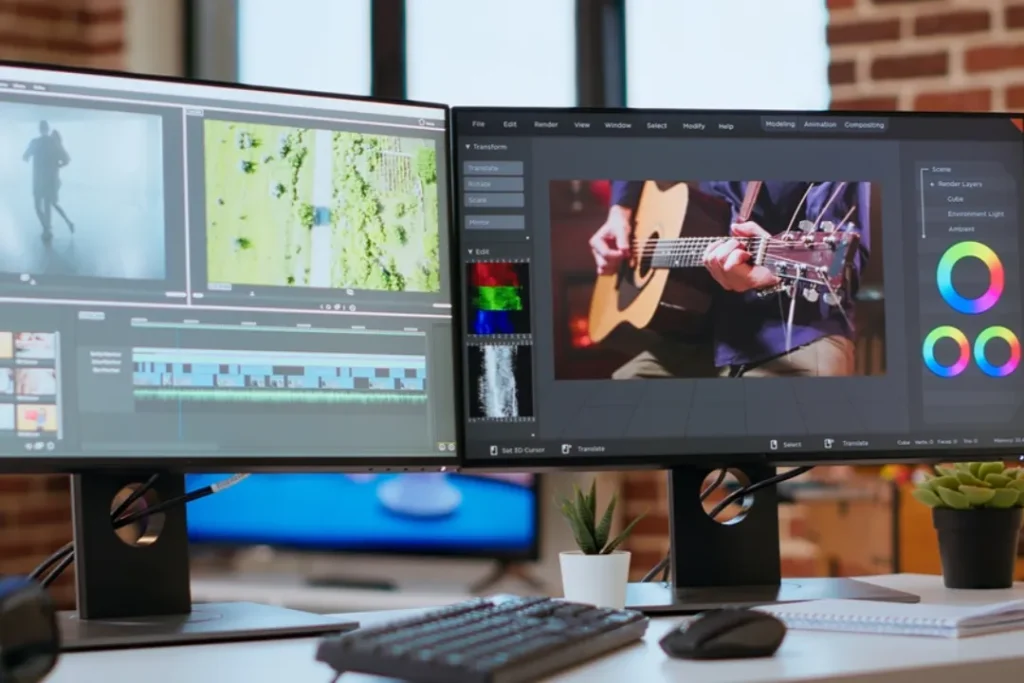
The digital landscape requires visual content at all times. Social media feeds, marketing campaigns, product catalogs, and websites all require new and interesting imagery and video. Traditional methods require expensive software, specialist skills, and hours of work. Modern technology has changed this equation completely.
Professional-quality visuals have become available for everyone. Whether you have a small business, are responsible for marketing campaigns, or produce content on a regular basis, the new generation of tools removes the technical barriers that have previously made the creation of visual content a specialist’s domain. There are four fundamental categories, as explained by this guide, and they are transforming the way we are developing and developing visual content.
This approach fits nicely into the larger scheme of automation. Organizations embracing these technologies in combination with other forms of productivity improvements experience dramatic improvement in content output and quality. The tools we’re going to take a look at represent different aspects of the visual content creation process, each of which solves specific challenges that businesses face every day.
Creating Images from Text Descriptions
Text-to-image technology has developed incredibly over the last two years. These platforms are based on interpreting the written description and producing corresponding visuals in seconds. The way the technology works is by understanding the relationships between words and visual concepts and then building pictures that correspond to the words in the description.
The areas of practical application are extremely wide. Marketing teams create ad creatives and post graphics on their social media without weighing down design resources. Product teams visualize things before entering the production phase. Content creators depict blog posts and articles using custom imagery that is a perfect fit for their message. E-commerce businesses create lifestyle shots and variations of the product with no expensive photo shoots.
A number of platforms lead in this space, and each of them has different strengths. Some are good at photoreal outputs that can be used for commercial purposes, while others are good at artistic and stylized imagery. The choice depends to a large extent on your specific needs and the existing workflow.
For businesses that need commercial-safe assets, platforms that are constructed using licensed training data offer legal certainty. Others are providing unbelievable amounts of creative control with the engineering of prompts and parameters. Open-source options provide the technical teams with the flexibility to self-host and tailor to meet privacy concerns and allow for unlimited generations.
The secret to success is learning how to successfully communicate with these systems. Vague descriptions do not result in better results than detailed prompts that specify style, composition, lighting, and mood. Many platforms now come with the reference image capabilities where you can show rather than tell what you want. This combination of text and visual reference produces some very precise outputs.
Recent developments include better text rendering inside pictures, better handling of human features, and the ability to keep the character the same character across multiple generations. These developments make the technological breakthrough feasible for professional applications where quality and reliability are important factors.
Producing Video Content Without Technical Skills
Video creation is perhaps the most dramatic change in content creation. What would once have required cameras, actors, locations, and editing expertise can now come about via text prompts or uploaded images. The technology examines physics, motion, lighting, and composition in order to produce realistic moving footage.
The impact on business is enormous. Companies create training videos, product demonstrations, and marketing content at a fraction of the traditional costs. Social media managers produce engaging short-form content on a daily basis, rather than a weekly basis. Sales teams record video messages for prospects without the use of recording equipment. Educational organizations create visual learning materials in a quick way.
Different platforms are used for different needs. Some are focused on ultra-realistic video, which could be suitable for professional productions, while others are speed and ease of use for creating high-volume content. Avatar-based platforms offer the possibility of talking head presentation without having to make a physical appearance yourself, especially useful for multilingual presentations and regular corporate communications.
The technology is responsible for a number of different workflows. Text-to-video creates entirely new video race information out of descriptions. Image-to-video brings on life with static pictures, such as bringing to life product photos or illustrations. Video-to-video applies the style transfer or improvements on the existing footage. Each approach provides a solution to different content issues.
Present capabilities are multi-minute videos, which consist of constant scenes, camera actions that recreate cinema effects, and natural sound creation aligned with visuals. The quality of the motion has been dramatically improved, the physics simulation is better, and the temporal consistency makes all the flickering and artifacts that were present in previous versions a thing of the past.
Practical limitations have been overcome Most platforms limit video length to seconds or minutes as opposed to longer pieces. Complex camera movements and/or complex physics can still result in results that are not realistic. Character consistency across scenes – must be carefully prompted or have special features However, for most business video needs, current technology is providing professional results.
Integration with existing workflows is important to a large extent. A few tools just output directly to editing software, whilst other complete production environments are available. When choosing the platforms, consider the place of the generated content within your general content pipeline.
Crafting Thumbnails That Drive Clicks
First impressions are deciding factors on whether content is viewed. For video platforms, blogs, and social media, thumbnails are essential points of decision-making. A good thumbnail can double or triple the click-through rates, which directly affects the visibility and success.
Specialized thumbnail creation tools are based on the analysis of high-performing patterns in specific niches and the automatic application of proven design principles. They mark significant moments in the visual and write interesting captions and create several variations to test them. This method of designing based on websites with real data means that we have eliminated guesswork, understandably, in the design of thumbnails.
The problem with thumbnails is that they are small and they play a competitive game. Designs must communicate well when they are presented at microscopic preview sizes mixed in with dozens of alternatives. High contrast, bold text, expressive faces, and focal points all combine to make a stopping point for scrolling fingers.
Modern platforms take key frames from videos, which suggest the most visually captivating moments. They use text with ideal sizes and positions so that it is readable on all devices. Face detection capability recognizes the most interesting expressions. Style matching helps keep the content libraries consistent with the brand style.
Platform-specific optimization is crucial. YouTube thumbnails have different specifications than Instagram postings or blog featured images. Vertical video does require other compositions than horizontal. Tools with an understanding of these requirements for the platform produce better results than generic image generators.
Testing capabilities make the difference between a basic tool and a professional tool. To determine what actually performs well with your audience, you might develop several other options of the thumb in black and white and compare their performance. Some platforms are integrated directly with analytics, which show which designs perform the most engagement.
The return it gets on thumbnail optimization is measurable and pretty big. Content creators report massive gains of views without altering the quality of the content. Better visibility of recommendation algorithms further builds upon such gains over time. For anyone who is publishing regularly produced video or written content, the quality of the thumbnails has a direct effect on success metrics.
Enhancing Image Quality Through Technology
Not all of the visual content starts out perfect. Photos may be low resolution, images may be old and degraded, or generated content may need to be improved. Enhancement technology fills these gaps in the quality using sophisticated analysis and reconstruction.
The process is not just resizing but works differently. Traditional upscaling is merely a process of getting bigger and bigger pixels that results in a blurry or pixelated appearance. Modern enhancement is done by analyzing the content of the image, knowing the patterns and textures, and then intelligently filling in the missing parts. The result comes out naturally sharp at the larger sizes.
Multiple types of enhancements have different applications. Resolution upscaling – this involves filling out images to a higher dimension for print or large screen display. Noise reduction subtracts the noise or grain in the photo from low light or heavily compressed files. Optimizing the vibrancy and correction with color enhancement. Restoration repair is used to repair old or damaged photographs.
E-commerce businesses try to use enhancement to keep the catalog consistent, increasing the size of the product shots without losing quality. Photography professionals prepare prints from digital files and are able to produce gallery-quality prints. Marketing teams take existing assets and use them for new campaigns that need new dimensions. The creators of content enhance screenshots or older content for current standards.
The selection of various enhancement modes has an important influence on the results. Conservative modes are true to originals with very little interpretation. Aggressive modes produce spectacular improvements but may include details that are not available in the source. The right choice depends on if accuracy or the most quality is more important for your use case.
Batch processing capabilities become essential when improving the large image libraries. Processing hundreds or thousands of images separately would be counterproductive in terms of time. Tools that provide batch operations using the same settings make the enhancement of large scale practical.
Quality trade-offs exist. Passive exaggerations may add artifacts or unnatural textures. Clever compression: images that have been badly degraded from compression may not clean up well. Source material quality is still important, although nowadays modern technology can work miracles on surprisingly poor inputs.
Platform Comparison and Selection
Choosing the right tools requires that you know what your specific requirements are. Different platforms have different strengths, and most professionals use several different tools instead of looking for a single one.
Here’s a practical comparison framework:
| Tool Category | Best For | Key Consideration | Typical Use Case |
| Image Generation | Marketing visuals, concepts | Commercial licensing vs. creative control | Social media graphics, ad creatives |
| Video Creation | Content at scale | Length limits vs. quality | Product demos, social content |
| Thumbnail Design | Platform optimization | Testing capability | YouTube, blogs, social platforms |
| Image Enhancement | Quality improvement | Preservation vs. transformation | Print preparation, catalog consistency |
Budget considerations are all the way up from totally free tiers to enterprise subscriptions. Free ones are fine for learning and occasional use. Professional applications usually pay for paid plans with time savings and more excellent results. Many platforms are available at credit-based pricing, allowing you to pay only for what you use without having to commit to monthly subscriptions.
Integration requirements are of great importance. Stand-alone tools have manual export and import procedures. Online products that integrate with your current creative programs, content management systems, or production workflows are less disruptive and are even time-saving.
The learning curve is quite different for different platforms. Some put the usability to have limited options, but it is immediate to me, first for simplicity. Others offer a lot of customization, which requires investment in understanding their capabilities. Match the complexity to the level to which your team is comfortable with you when it comes to technical know-how and committed to spending time on it.
Practical Implementation Strategy
Successfully adopting these technologies requires more than logging in to accounts. Start by identifying those of your visual content tasks that use up the most time or represent the greatest bottleneck. Deploy tools to address those specific pain points first and not try to do wholesale transformation.
Test out different options in each of the categories before you commit. Free trials are available for most of the platforms; that way you can test them with real work and not just features and capabilities. Capture what is effective and not so much, brainstorming institutional knowledge for your team.
Create templates and standard prompts of recurrent types of content. The consistency of this helps in improving the quality of output and accelerates the creation process. Share positive methods with your team, creating best practices used in addressing your brand and audience.
Quality control is always essential. It is important to check generated content prior to publication to ensure they meet the standards set by the brand, as well as accurately represent your message. Use automated production together with human judgment to get the best results.
Measure impact through measures that are important to your business. Reduced track time, volume of content produced, interaction, and quality. use this data on how to adjust your course and make a case for investing in tools that really do add value
Looking Forward
Visual content creation technology keeps improving at an increasing pace. What was thought to be impossible two years ago is now routine. This pace of improvement shows no signs of slowing down.
The future is likely to involve even longer video generation, better consistency of characters from sequence to sequence, and better integration with other business tools. Multimodal platforms will be the norm in which text, images, and video are handled in a unified workflow.
Success goes not to those with the best tools, but to those who best understand how to guide and develop the automated output. Technical capabilities are less important than strategic application and creative judgment. These technologies enhance human creativity and do not substitute human creativity.
Organizations that are bringing visual content tools into larger automation strategies are realizing compound benefits. Increased speed of content creation allows for increased testing and optimization. Better visuals bring about better engagement metrics. Reduced cost of production frees up resources for strategy and creativity.
So, the barrier to professional visual content has come down dramatically. Small teams now do what previously required agencies. Individual creators are in competition with established brands on visual quality. This democratization continues changing the landscape of digital marketing, content creation, and online business.
The question isn’t now whether or not to adopt these technologies, but how quickly and effectively you can integrate these technologies into your workflow. Those that master these tools are gaining great competitive advantages in content volume, quality, and speed to market.