
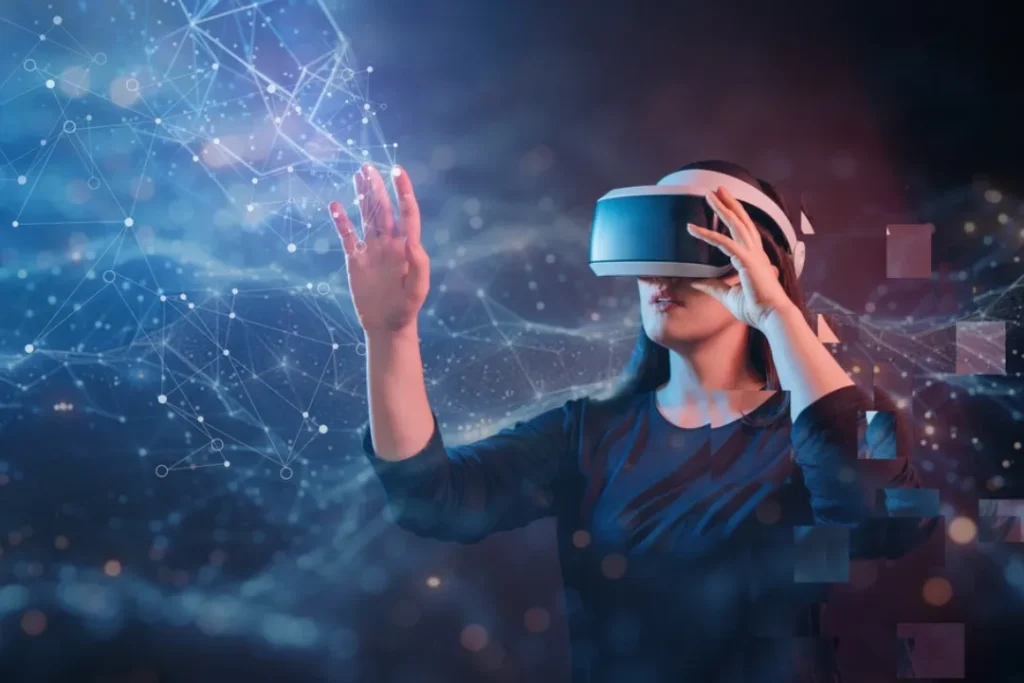
Augmented Reality (AR), Virtual Reality (VR) and the Metaverse are leading the way in technological innovation and transforming industries and redefining digital experiences. In 2025 there is an increasing access and sophistication to AR and VR technologies and a new digital frontier is emerging in the form of the Metaverse. This article delves into the recent trends in AR and VR, what Metaverse is and how with the transformative impact of VR in Education and Training.
The Evolution of AR and VR Technology
AR and VR technologies are rapidly evolving and are providing immersive and interactive experiences that were once the stuff of science fiction. One of the biggest trends is the creation of lightweight, high-resolution headsets which offer a more comfortable, realistic user experience. These headsets of the next generation are equipped with advanced sensors and cameras, allowing for more precise tracking, and allowing for interacting with virtual environments. The resulting improvement in comfort factor has made it possible for people to wear these devices for long periods of time without feeling tired or uncomfortable, making them more practical for both professional and recreational use.
The improve resolution is also notable with modern headsets providing crystal-clear visuals that remove screen door effect that plagued the older VR devices. This improves visual fidelity and makes virtual environments more believable, and reduces motion sickness, two factors that have been prior limits to VR adoption. Additionally, there have been improvements in field-of-view to offer more natural peripheral vision to the user leading to even more immersion.
AI Integration: The Smart Future of Immersive Technology
Another revolutionary trend is the coming together of AR and VR with artificial intelligence and machine learning. AI-powered AR and VR applications can react to user behavior, delivering personalized experiences and real-time feedback. For example AI can be used on user interactions for VR environments to make training scenarios more efficient or even make gaming environments more of a blast by adjusting difficulty levels, suggesting content, or even predicting user preferences.
In the educational field, Artificial Intelligence (AI)-driven systems may determine when a student is having trouble with something, and automatically tailor the educational approach or offer extra support to them. In the gaming world, one of the many applications of AI is to generate dynamic narratives that react to their choices in order to make each playthrough unique. These intelligent systems learn from the behaviour of users over time, causing them to continually improve the experience and make AR and VR technologies more intuitive and responsive.
Cloud-based AR and VR platform are also gaining much traction for users to access VR immersive experiences without relying on powerful local hardware. This democratizes the access to AR and VR and makes it more accessible to a broader audience. By moving processing to distant computer servers, cloud platforms can provide even smartphones and light devices with the ability to deliver high-quality AR and VR experiences where it used to take expensive gaming computers.
Augmented Reality in Everyday Life
AR is becoming a more and more integral part of our daily lives, and it is causing the way we shop, navigate and interact with the world around us to change. In retail, AR makes it possible for customers to see what products look like in their own homes before they buy, and it can greatly improve the shopping experience. Furniture retailers, for example, enable their customers to visualise what a sofa would look like in their living room by using their smartphone camera. This limits returns and makes customers more satisfied as they’ll make more informed choices about their purchases.
In the realms of marketing, AR technology is employed to create both interactive marketing advertisements and immersive brand experiences via AR, bringing attention in ways traditional advertising cannot. Brands are creating AR philtres and experiences for consumers to virtually try things on, from makeup to sunglasses, and creating fun touchpoints that bridge the gap of digital and physical retail.
Navigation has been revolutionised due to AR technology. AR navigation apps can give step by step directions actually overlaid on the real world and through the smartphone camera with points of interest highlighted in real time. This makes it a lot more intuitive to find your way in unfamiliar environments with the digital arrows and information seemingly floating on the streets and buildings around you to get you to where you need to be.
Virtual Reality in Entertainment and Gaming
VR is revolutionizing the field of entertainment and gaming industries by offering immersive and interactive experiences that engage the users on new levels. VR gaming: VR gaming enables players to enter virtual worlds and interact with the environment and characters in new ways that were previously impossible. This results in more interesting and realistic gaming, where players physically move around, gesture and look around, naturally within game worlds.
The presence in VR gaming is remarkable. Players are shown peeking around corners and ducking behind cover and are able to reach out to interact with objects just as they would in the real world. This physicality does add a new aspect to the gameplay, which makes the gameplay more memorable and emotional. The ever-expanding library of VR games covers all types of games ranging from puzzle games to action-adventures and is gaining a more diverse audience of gamers over time.
In the field of entertainment, VR technology is being employed to produce immersive movies and live entertainment. Users can attend virtual concerts, theatre performances, and sports events and experience them as if they were physically present. This has opened up new possibilities for content producers and audiences alike, enabling people from anywhere in the world to have premium entertainment experiences without any of the limitations of geography or venue capacity.
Understanding the Metaverse
The Metaverse is a collective virtual shared space brought about by a virtual and physically persistent virtual spaces coming together as well as a virtually enhanced physical reality coming together. It is a digital universe in which users can interact with each other and digital environments in real time using AR and VR technologies. The Metaverse is not a single platform but a network of interconnected virtual worlds, where users are able to socialize, work, play and create.
In the Metaverse, users can create and personalize avatars (digital versions of themselves) to explore virtual environments, attend events, and participate in social and economic activities. The Metaverse is powered by advanced AR and VR technologies, block chain for digital asset ownership and AI for personalized experience. This combination provides a digital world that endures and develops even in the absence of individual users from the system.
The Metaverse is still in its early stages, but it has the potential to revolutionize the way we interact with digital environments. It has the potential to revolutionize industries like entertainment, education and commerce, as well as open up new opportunities for innovation and growth. The concept is a complete revolution in the way we think about online spaces, from flat screens to websites to full, immersive three-dimensional spaces.
Social Interaction and Digital Community Building
One of the most exciting aspects of the Metaverse is the potential for social interaction and collaboration. Users can meet and interact with others in virtual environments, attending events, participating in discussions and collaborating on projects. This has led to new opportunities for socialising, networking and teamwork, irrespective of physical location. Virtual offices let you get away with working as if you were in the same office as your remote colleagues, and virtual social spaces help you to stay friends with people on the other side of the world.
The Metaverse is also introducing the concept of own digital assets, which is possible with the help of blockchain technology. Users can buy, sell and trade virtual goods and assets, including virtual real estate, clothing, and art. This is bringing new economic opportunities and a thriving digital economy within the Metaverse where virtual land can accrue value and digital fashion items can become status symbols.
VR Transforming Education and Training
VR is changing the face of education and training by allowing immersive and interactive learning experiences for students that engage them in ways that traditional methods cannot. In education, VR can be used to let students study history by visiting historical sites, perform virtual science experiments, and experience simulated real-life situations. History students can take a tour of ancient Rome or biology students can take a tour of the human body and geography students can go to any remote location – all from their classroom.
Medical students can perform surgeries in virtual reality, and they will gain hands-on experience without the dangers of performing the real procedure. This enables them to make mistakes and is able to learn from them without the fear of consequences by practising in a consequence-free environment, gaining confidence and competence before working with actual patients. The ability to repeat procedures a number of times helps speed up the learning process and gives better outcomes.
In the training of professionals, VR is used to simulate real-world scenarios where the trainees can practice their skills in a safe and controlled environment. Pilots can use VR simulators to practice flying maneuvers and emergency procedures and emergency responders can practice for disaster scenarios. VR training is also being utilized in other industries, such as manufacturing, where employees can practice operating complex machinery in virtual environments, minimizing the risk of accidents and equipment damage.
Benefits and Accessibility
VR in education has a number of benefits, including being able to be more engaging, better retention, and the ability to practice skills in a safe and controlled environment. Immersive VR experiences can be used to grab the attention of students and make learning more enjoyable, which can result in better results. Studies have shown that for experiential learning through VR to be higher than traditional lecture-based education.
VR technology is becoming more accessible, and as a result, it has become possible for an increasing number of students and trainees to take advantage of immersive learning experiences. This inclusivity can be especially important for students with disabilities, who may not be able to participate in traditional hands-on activities. VR can lead to alternative ways of how these students can engage with educational content, developing important skills and levelling the playing field, ensuring equal access to quality education.
Looking Ahead
AR, VR and the Metaverse are leading the technological innovation by providing immersive and interactive experiences that are revolutionising industries and redefining digital experiences. The new trends in AR and VR, the rise of the Metaverse, and the transformative effect of VR in education and training are just a few of the examples of how these technologies are shaping the future. As AR and VR technologies continue to evolve and the Metaverse becomes more accessible, we can expect to see even more innovations and opportunities in the years to come.
Frequently Asked Questions
What’s the difference between AR and VR?
AR works by keeping digital information on top of your world through devices such as smartphones or AR glasses to enhance the things that you are seeing around you. VR produces fully immersive digital environments as a replacement to the real world by means of, commonly with the help of VR headsets that block out the physical surroundings.
Do I need expensive equipment to experience AR and VR?
Not necessarily. Many experiences that use AR are available for use on normal smart phones, while VR headsets that require a bit of investment are becoming more affordable. Cloud based platforms are making higher quality experiences accessible on less powerful devices but higher quality experiences still benefit from dedicated hardware.
Is the Metaverse the same as VR?
No. VR is a form of technology that allows us to experience immersive digital experiences, whereas the Metaverse is an overarching term, a network of interconnected virtual worlds that will integrate VR, AR, blockchain and AI into a persistent virtual digital ecosystem where people will be able to socialize, work and conduct business.
How is VR being used in education today?
VR is used for virtual field trips to historical locations and those that are hard to access, hands-on science experiments, medical training simulations, professional skills-training across industries, and accessible learning experiences for those students with disabilities who may have limitations in doing hands-on learning.
What industries are being transformed by AR and VR?
Major industries are education and training, healthcare and medicine, retail and e-commerce, entertainment and gaming, real estate, manufacturing, tourism and professional services. These technologies are opening new opportunities in terms of their operations and the way in which these industries serve the customers.
Is the Metaverse safe for children?
Like any online site, parent oversight of the Metaverse is a necessity. Some of the platforms have age limits and parental controls. Parents should keep an eye on the activities of their children, use age-appropriate platforms, and educate children about online safety, privacy and proper behavior in virtual spaces.