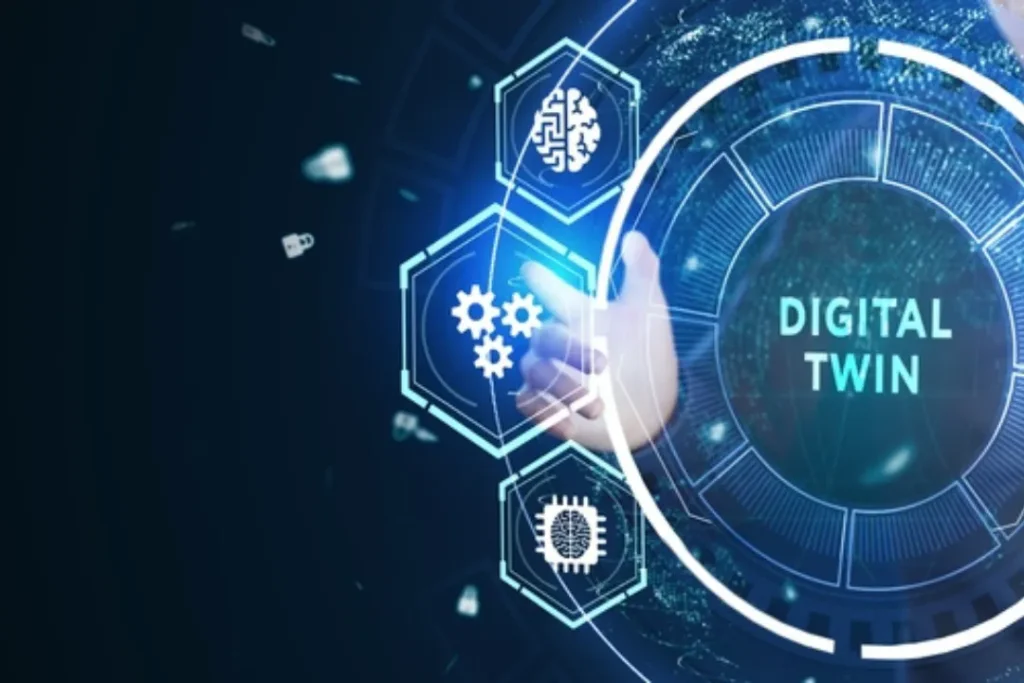
Digital twin technology is changing the way businesses work by making virtual copies of real things, processes, and systems. By 2026, digital twins will have become dynamic, adaptive, and predictive models thanks to improvements in AI, the IoT, and real-time data integration. These virtual copies let businesses run simulations, predict changes, and give useful information that can help them make better decisions and improve their performance.
What Is Digital Twin Technology?
A digital twin is a virtual model of an object or system that uses real-time data to show how it works and behaves in the real world. Think of it as a digital mirror that shows not only how something looks but also how it acts, reacts to different situations, and works over time. Digital twins give businesses a complete and up-to-date picture of their physical assets by combining data from IoT sensors and other sources. This enables businesses to monitor, analyze, and enhance their operations.
Digital twins are much more than just 3D models or simulations. They are dynamic, always-changing representations that include real-time data streams, past performance data, environmental conditions, and predictive analytics. This combination makes a powerful tool that helps businesses better understand their assets, predict how they will act in the future, and improve operations in ways that weren’t possible before.
Key Components That Make Digital Twins Work
Data Integration: Digital twins need data from many different sources to be accurate and useful all the time. IoT sensors built into physical assets gather real-time performance data, such as temperature, pressure, vibration, and operational status. External data sources give you information about things like the weather, energy prices, and the state of the supply chain. Historical data allows for trend analysis and training of machine learning models. Real-time data feeds make sure that the digital twin always shows the most up-to-date information.
This constant flow of data from many different places gives a full picture of the asset’s status and environment, which makes simulations and predictions more accurate.
Simulation: Advanced simulation capabilities let digital twins model and predict how a system will act in different situations. Companies can try out different situations in a virtual setting, answering “what if” questions without putting their real assets at risk. Simulations can show how design changes will affect a system, guess how it will react to different operating conditions, test optimization strategies before putting them into action, and see how maintenance schedules will affect the system.
This simulation feature lets businesses improve their processes and try out strategies before putting them into action in the real world, which lowers the risks and costs of trial and error.
AI and Machine Learning: AI-powered predictive analytics and automated decision-making make digital twins smarter and more adaptable, so they can change on their own when conditions change. Machine learning algorithms look for patterns in data to predict failures before they happen, find chances for optimization that people might miss, automate routine decisions and changes, and make predictions better as more data comes in.
AI integration turns digital twins from static models into smart systems that can make suggestions, find problems, and even control physical systems on their own.
Real-World Applications Transforming Industries
Manufacturing: Optimizing Production
Digital twins are completely changing the design, production, and maintenance processes in manufacturing. Digital twins help businesses improve their workflows by finding bottlenecks and inefficiencies, cut down on downtime by using predictive maintenance to stop unexpected failures, raise the quality of their products by keeping an eye on and changing processes in real time, and speed up innovation by testing new designs and processes in a virtual setting.
Real-time monitoring and predictive maintenance can help keep equipment from breaking down and make assets last longer, which lowers costs and boosts productivity. For instance, a manufacturer might make a digital twin of an entire production line and try out different production schedules to find the best setup that gets the most work done while using the least amount of energy and putting the least amount of stress on the equipment.
Major manufacturers say that after using digital twin technology, they have cut downtime by 30–50% and increased production efficiency by 20–25%. This shows how useful this method can be.
Healthcare: Personalizing Medicine
Digital twins are changing healthcare in amazing ways by making personalized medicine possible and improving patient outcomes. Virtual models of patients enable customized treatment plans based on unique characteristics, virtual clinical trials that evaluate treatments on digital twins prior to human trials, surgical planning where surgeons rehearse intricate procedures on patient-specific digital twins, and expedited drug development through the simulation of drug effects on virtual organs and systems.
Simulations improve the development and testing of medical devices by showing how they will work in different situations. Digital twins also make hospitals run better by improving facility management and energy efficiency, speeding up patient flow to cut down on wait times, using resources more effectively, and planning for different levels of demand.
For instance, being able to make a digital twin of a patient’s heart lets cardiologists try out different treatments in a virtual setting and choose the one that is most likely to work for that patient.
Smart Cities: Urban Optimization
Smart cities are using digital twins to improve services and infrastructure on a city-wide level. Virtual models of whole cities or neighborhoods let city planners test out different traffic patterns and mobility options to improve traffic flow, make data-driven decisions about infrastructure design, make sure utilities and services are used efficiently, plan for population growth and changing needs, and improve public safety and emergency response through scenario planning and simulation.
Digital twins of transportation networks help cities cut down on traffic by letting them try out different ways to manage traffic in a virtual setting. Digital twins help energy grids distribute power more efficiently and connect renewable energy sources. Digital twins help water systems find leaks, guess when pipes will break, and make water treatment processes work better.
The Virtual Singapore project in Singapore is a good example of what can be done. It makes a detailed digital copy of the whole country that can be used for urban planning, environmental monitoring, and scenario analysis.
Energy: Grid Optimization and Resilience
Digital twins are making the energy sector much more efficient and making the grid more resilient. Virtual models of energy systems let businesses keep an eye on and improve energy production from different sources, cut down on losses and improve reliability by optimizing distribution, manage consumption through demand response programs, predict and stop outages before they affect customers, and better integrate renewable energy sources.
Predictive maintenance and scenario planning can help keep systems running smoothly and avoid outages. Digital twins help energy companies test how adding renewable energy sources will affect the grid, try out different grid setups, and find the best way to store energy.
Wind farms use digital twins to improve how well turbines work depending on the weather. This increases the life of the equipment and the amount of energy it produces.ergy it produces.
Construction and Real Estate: Building Smarter
Digital twins powered by Building Information Modeling (BIM) help architects and engineers make the best designs that balance beauty, function, cost, and sustainability in construction and real estate. By keeping an eye on how building systems are working, finding ways to make them better, spotting problems before they become problems, and making sure people are comfortable while lowering energy costs, real-time monitoring makes facilities more energy-efficient and easier to maintain.
AI-powered construction site simulations make the work safer and more efficient by finding potential dangers, improving the timing of material deliveries, keeping track of progress against plans, and improving communication between contractors.
Digital twins help building managers keep track of everything from HVAC systems to elevator maintenance, and they can cut building operating costs by 20 to 35%.
Agriculture: Precision Farming
Digital twins are helping farmers grow crops more accurately and make their supply chains work better. Virtual models of farms and crops let you keep an eye on and improve irrigation in real time to cut down on water use, fertilizer use to cut down on waste and environmental impact, pest control to make sure that interventions are aimed at the right pests, harvest timing to get the most yield and quality, and supply chain logistics to cut down on waste and improve freshness.
Farmers can try out different planting methods, see how weather patterns affect their crops, and make their operations as efficient as possible while having the least amount of impact on the environment. This data-driven way of doing things is making farming more productive and sustainable.
Benefits of Digital Twin Technology
Real-Time Monitoring and Visibility
Digital twins let businesses keep an eye on their physical assets in real time, so they can find and fix problems quickly before they get worse. This extra visibility makes operations run more smoothly, cuts down on downtime, and gives you more information than ever about how well the system is working. Companies can see what’s going on in real time across their whole operation, no matter where they are.
Predictive Maintenance Revolution
Digital twins help with predictive maintenance, which helps keep equipment from breaking down and greatly increases the life of assets. By using machine learning to look at real-time data and guess what problems might happen, companies can plan maintenance based on the actual condition of their equipment instead of random schedules. This can cut down on unplanned downtime by up to 70%, extend the life of equipment by 20-40%, and lower maintenance costs by only doing it when it is needed.
This change from scheduled or reactive maintenance to predictive maintenance is one of the best uses of digital twin technology.
Optimization and Efficiency Gains
Digital twins help businesses make their processes and workflows better, which makes them more efficient and cuts costs across all of their operations. Advanced simulation tools let you plan scenarios and test strategies without interfering with real operations, which leads to new ideas and better performance. By testing improvements in a virtual environment and only making the most promising changes, organizations can keep getting better.
Personalization and Customization
Digital twins can be changed to fit specific needs, which lets businesses offer personalized products and services. Digital twins are used in industries that deal with customers, like tourism, to mimic customer preferences and behaviors, which makes it possible to offer more personalized services. Digital twins make mass customization possible in manufacturing by letting you try out different product configurations without having to change the tools on the production lines.
Challenges and Considerations
Data Accuracy and Quality
For digital twin technology to work, it needs accurate models and real-time data integration that works. Companies need to make sure that their digital twins are built on accurate, high-quality data that is properly calibrated, regularly checked, synchronized across systems, and safe from mistakes and corruption. Bad data quality makes predictions wrong and decisions less effective, which makes digital twins less useful.
Integration Complexity
It can be hard and complicated to connect digital twins to systems and processes that are already in place. To connect digital twins with IoT devices and sensors, existing enterprise systems like ERP and MES, analytics and AI platforms, and control systems for automated decision-making, organizations need to put money into strong design and integration efforts. To make sure that everything works smoothly and gets the most value, this integration needs careful planning, skilled workers, and regular maintenance.
Security and Privacy Concerns
Digital twins store private information about physical assets, operations, and performance, so security and privacy are very important. Organizations must put in place strong security measures to protect digital twin data from unauthorized access and cyber attacks, make sure that data privacy is protected and that rules are followed, stop digital twins from being changed in ways that could affect physical systems, and make sure that communications between digital twins and physical assets are safe.
If a digital twin is hacked, attackers could learn a lot about physical systems or change how they work, which is why security is so important.
Cost and ROI Considerations
To use digital twin technology, you need to spend a lot of money on IoT sensors and connectivity, software platforms and analytics tools, skilled workers to build and maintain digital twins, integration with current systems, and ongoing costs of running the technology. Organizations need to carefully look at the expected returns, which could include less downtime, more efficient work, better decision-making, and new ways to make money. Costs can be high, but successful implementations usually show a positive return on investment (ROI) within 12 to 24 months.
The Future of Digital Twin Technology
Accelerating Adoption
Digital twin technology is likely to grow quickly over the next few years as more businesses use it to boost performance, efficiency, and sustainability. Market research says that the digital twin market will grow from $16 billion in 2024 to more than $110 billion by 2032. This is because of improvements in IoT, AI, and 5G connectivity. The use of AI, IoT, and real-time data together will lead to more adoption and innovation, which will open up new applications and use cases.
Industry Transformation
Digital twins are changing industries by making it possible to monitor things in real time, predict when they will need maintenance, and optimize them on a scale that was never possible before. Digital twins are making things better and more efficient in a wide range of fields, from manufacturing to healthcare to smart cities to energy. Adoption will speed up across industries as more success stories come out and best practices are set.
Innovation and Development
As digital twin technology gets better, new ideas will come up. These include better AI integration for making decisions on their own, better interoperability so that digital twins can talk to each other across systems, edge computing integration for faster local processing, blockchain integration for safe data sharing, and quantum computing for complex simulations. Companies will keep spending money on digital twin platforms to make sure their operations are reliable and efficient. Digital twin technology has a bright future. It is expected to keep getting better and more people will start using it in the coming years.
Frequently Asked Questions
How much does it cost to create a digital twin?
The cost depends a lot on how complicated it is. Digital twins of simple assets can cost between $10,000 and $50,000, while digital twins of complex systems like cities or manufacturing plants can cost millions. Subscription models on cloud-based platforms are making digital twins cheaper for smaller businesses.
What’s the difference between a digital twin and a simulation?
Simulations are models that run different scenarios, but digital twins are always getting new data from their real-world counterparts. Digital twins show how physical assets are right now and change with them. Simulations, on the other hand, are usually one-time tests based on guesses.
Do I need IoT sensors for digital twins?
Digital twins are most useful when they get real-time data from IoT sensors, but you can also make them using existing data sources, manual inputs, or measurements taken at regular intervals. IoT integration, on the other hand, greatly improves the ability to predict and optimize in real time.
Can digital twins work offline?
Digital twins can work even when the internet is down by using past data and processing it locally. However, they are most useful when they have real-time data all the time. Edge computing lets digital twins work on their own, with cloud syncing happening from time to time.
What industries benefit most from digital twins?
Manufacturing, energy and utilities, healthcare, aerospace and defense, automotive, construction and real estate, smart cities, and agriculture are all industries that have complicated physical assets that benefit the most. Any business that runs complicated systems or infrastructure can benefit.
Could you let me know the typical timeframe for implementing a digital twin?
For simple asset twins, the time it takes to set them up can be anywhere from 3 to 6 months. For complex system twins, it can take 1 to 2 years. To prove ideas and gain experience before scaling, start with pilot projects that focus on high-value assets.
What skills are needed to work with digital twins?
Some of the most important skills are knowledge of IoT and sensors, data analytics and visualization, AI and machine learning, systems integration, and software development. At first, many businesses work with specialized vendors or consultants.
How do digital twins relate to the metaverse?
The metaverse has digital twins that stand in for real-world objects and systems, but it also includes places that are only virtual. Digital twins focus on mirroring and optimizing physical reality, while the metaverse encompasses broader virtual experiences and interactions.