
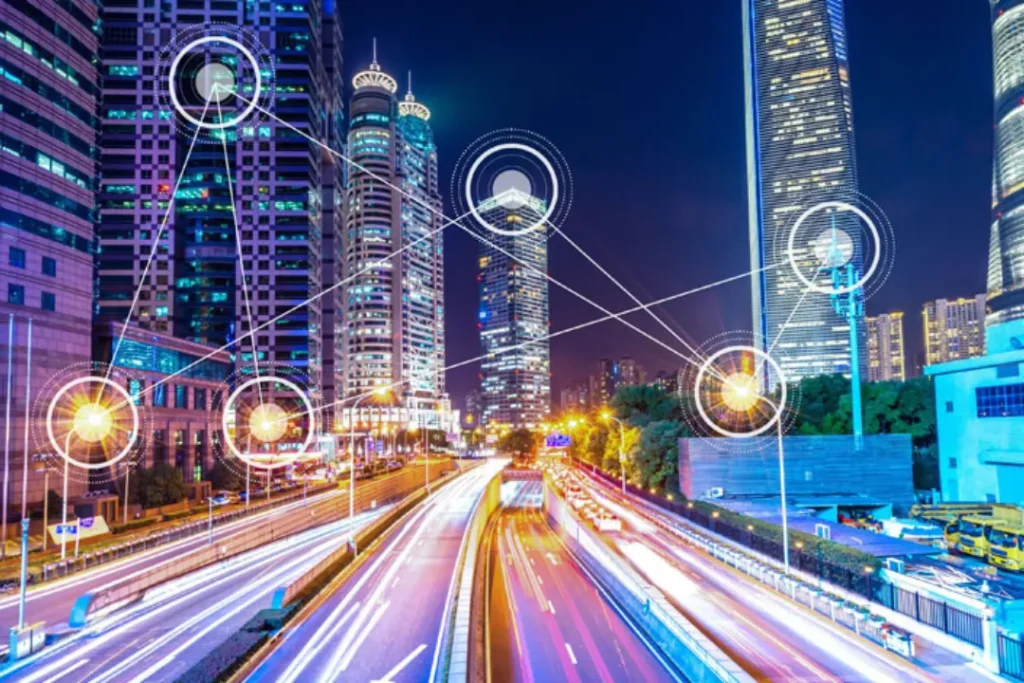
Our surrounding world is getting smarter, and more so; it is happening faster than many can reason. It is your morning coffee machine that will brew a cup of coffee when your alarm clock switches on, your traffic lights that will vary the schedules whether there is a traffic jam or not, and your factory machines that will know when they will require a service before breaking and falling or not, none of this is a science fiction situation. Each of these examples demonstrates what the Internet of Things will look like in 2026.
Now, 18 billion devices are connected to the internet, communicating, interacting, and gathering data. By 2030, this number could rise to 40 billion. This giant web is altering how cities are operated, factories are manufactured, and our computerized lives are becoming more secure.
What Makes 2026 Different for Connected Technology
The interconnected system of devices has been transformed significantly. The simple sensor networks have become complex systems that are capable of learning, adapting, and decision-making. The market size has increased to close to 1.8 trillion, which has been brought about by three significant forces that act in unison.
Firstly, 5G networks are fulfilling their promise. The change in speed and the reduced latency rate ensures devices can communicate almost instantly. A car that is self-driven can now respond to the changing road conditions in milliseconds as opposed to seconds. Second, edge computing has brought the data processing nearer to the point of occurrence. Your smart home does not necessarily need to transmit information to a remote server and wait to be served back a response, it can take decisions on its own, precisely at the point of need. Thirdly, artificial intelligence has infused connective systems, enhancing their intelligence beyond mere automation.
Predictive maintenance in manufacturing. The sensors check equipment vibration and temperature; edge computing processes that data are processed in real-time, and machine learning algorithms detect patterns that indicate the imminent failure. The system then automatically sets the time the machine is to be serviced before it fades away thousands in the cost of repair and missed production time.
Another strong example of this type of computing can be seen in the healthcare sector. There are dozens of health measurements continuously being monitored with wearable devices. These devices, together with AI analysis, will be capable of detecting abnormal heart rates, anticipating diabetic conditions, or informing a doctor about worrying trends before the symptoms get severe.
How Smart Cities Are Building Tomorrow’s Urban Infrastructure
Take a stroll in any prime city of North America, and you will find that the infrastructure appears to be no different as it was many decades ago. However, there is a fundamental change occurring beneath the surface that we may not be aware of. In cities, networks of sensors and other systems are being installed that change how urban areas operate.
Traffic jams have cost the US economy more than 120 billion a year in lost productivity and fuel wastage. This is solved by the smart traffic management systems that monitor traffic within a whole city and dynamically adjust the timing of signals. In case a major accident occurs, the system can automatically divert traffic and this will keep the ripple effect of congestion that would have been experienced to spread miles away at bay.
Another significant challenge is the use of energy. Conventional power grids consume vast quantities of power inefficiently because they fail to monitor energy usage in real time and distribute it effectively. Smart grids are based on interconnected sensors along the distribution network and achieve on-demand supply and demand balancing in real time. The system during the times of peak usage may turn down the power of non-essential systems or tap into battery reserves to avoid overloading. These optimizations have reduced the energy bills in some cities by 20–30%.
Connected surveillance and emergency response systems have revolutionized the concept of public safety. When a crime occurs, networked cameras can track the suspects at multiple intersections. Accurate positioning and information immediately alert the emergency services. There are cities that have adopted such systems appropriately, and therefore the response times have reduced drastically.
The focus on environmental monitoring is an emerging trend whereby cities strive to achieve climate-related objectives. The sensor networks monitor the quality of air, purity of water, and pollution rates in cities. Readings that are beyond the safe levels activate automatic warning messages to the concerned agencies at the time.
| Smart City Application | Primary Benefit | Typical Impact |
| Intelligent Traffic Management | Reduced congestion | 25-35% less travel time |
| Smart Energy Grids | Optimized distribution | 20-30% lower costs |
| Connected Public Safety | Faster response times | 40% quicker emergency response |
| Environmental Monitoring | Data-driven decisions | 15-25% emission reduction |
Industrial Applications Reshaping Manufacturing
Manufacturing floors have been noisy and complex places with machinery. However, with the Industrial Internet of Things, these spaces are becoming data-intensive ecosystems where all equipment in them informs both its state, performance, and requirements.
One of the most significant changes is the transition to predictive maintenance. Conventional maintenance took either of two forms, namely, repair when it fails or maintenance on a regular schedule without regard to its actual state. Both approaches waste money. Sensors are linked to equipment that will keep a watch on their vibration patterns, temperature changes, power usage, and dozens of other parameters. This data is processed by machine learning algorithms to detect the minor trends that are precursors of failures. The maintenance teams are sent alerts days or weeks beforehand, and sufficient time is allowed to plan the repairs during planned downtime. Firms that have adopted this method have reduced their maintenance expenses by 35 percent and the unexpected downtimes by 60 percent.
Connected inspection systems have further streamlined the quality control and made it more consistent. There are computer vision cameras that take pictures of all the products that go off the line. AI algorithms that are trained on millions of images will see defects that human inspectors may fail to notice, particularly after hours of tedious work. A food processing company achieved a yield of 93 to 97 percent by detecting defects early in the manufacturing process. That can pass as a little stepping up, but when multiplied by millions, it equated to millions of dollars in saved material and high output.
The asset tracking system has increased the supply chain visibility significantly. RFID tags and GPS sensors will enable the companies to track the position and status of materials and products of the entire logistics chain. The shipments that are temperature sensitive can be tracked to maintain the temperatures at an acceptable level. The visibility also minimizes waste due to spoilage, enhances accuracy in the delivery, and assists businesses to have optimal inventories.
Wearable sensors and environmental monitoring have increased worker safety. Construction employees are provided with instruments that detect indicators of either heat exhaustion or exposure to hazardous gases. Sensors are applied in the factories to identify the dangerous conditions prior to exposing the workers. In the event that safety limits are overstepped, the workers as well as supervisors are alerted instantly.
Security Challenges You Need to Understand
The features that make devices useful also make them vulnerable, as the same connectivity can be exploited. Each interconnected device is a potential capability of the attacker, and the figures are frightening. The number of hacking attempts against devices connected to the Internet has reached an average of 820,000 each day, which is 46 percent more than the level of the prior year. Over half of all interconnected equipment contains one or more critical vulnerabilities, which may be exploited.
Device design and implementation typically lead to security vulnerabilities in connected systems. Numerous machine models are even shipped with default passwords, such as “admin” or password. Automated scripts launch attacks on the internet, searching for devices with these predictable credentials. Attackers have a way of utilizing the access to one device as a stepping stone to other more valuable systems within the same network once they have gained access to the device.
The number of breaches is colossal due to outdated firmware. Research shows that patches are available for 60 percent of successful attacks, yet they remain unimplemented. The difficulty is that renewal of thousands or millions of distributed devices is hard work. There are devices that have been in use for years without being updated on security.
Network security problems exacerbate these device-level issues. Studies indicate that poor segmentation is observed in 77 percent of networks in that the devices that are connected can interact with key business systems. Once a hacker has gone through a smart thermostat or surveillance camera, he or she should not be able to gain access to financial databases or customer accounts. However, network designs often allow for this type of lateral mobility.
The healthcare sector faces particularly perilous risks. Medical devices are usually equipped with old operating systems, which cannot be updated easily. The mean price of a medical data breach is more than 10 million dollars. Operational technology ransomware attacks have increased 46% in manufacturing.
| Security Risk | How It Happens | Best Defense |
| Default Credentials | Devices keep factory passwords | Mandatory password changes, Multi-factor authentication |
| Outdated Firmware | No update process or abandoned products | Automated updates, Vendor support agreements |
| Poor Network Segmentation | All devices on same network | VLANs, Zero-trust architecture |
| Physical Tampering | Devices in accessible locations | Tamper-evident designs, Encryption |
Protecting Connected Systems
The construction of security in interconnected systems cannot be done in an isolated manner and should be done at various levels to deal with vulnerabilities. Network segmentation forms the basis. VLANs and firewalls should be used to isolate connected devices and critical business systems. Even if a hacker manages to breach a device, they should encounter obstacles when attempting to penetrate further into the network. Costs of breaches at companies that have appropriately segmented have reduced by 35 percent.
Authentication and access control must be sound at the beginning of the game. Each device shall possess its credentials. Do not use the same password in another device. Where possible, multi-factor authentication must be used. The least privilege rule is also applicable in this case. Access to the device should be restricted to the network resources that it requires to operate, no more.
Encryption protects data in storage and during network transit. All the communication is supposed to be done using the latest protocols such as TLS 1.3. Strong algorithms should be used to encrypt data at rest; hence, in case of physical theft of a device, the data contained in the device is still secure.
Nonstop surveillance is now needed to identify threats at an early stage. Contemporary security platforms employ machine learning to identify the baseline behaviors of machines and networks. Whenever an object is not at that threshold, such as unfamiliar data transfer, unforeseen connection, or unusual behavior patterns, the system will raise an alarm. The top platforms are even able to respond automatically when the compromised devices are isolated before they can propagate malware or exfiltrate data.
Zero-trust architecture is a paradigm change in network security. The traditional model presupposed that everything beyond the perimeter of the network could be trusted. Zero trust presupposes that all connections could be vulnerable and have to be verified on a regular basis. This strategy suits especially well-connected direct device environments where the perimeter is poorly defined and devices are widely dispersed.
The Path Forward
The connected device revolution is not something that is going to happen in the future. It is currently happening, transforming industries and creating both opportunities and challenges. The technology is now mature, and the question is no longer whether to use it, but how to do so safely and effectively.
In the case of businesses, that would entail coming up with all-inclusive plans that can ensure implementation and security upfront. Those organizations that have performed best are those that commence pilot projects, learn during the first deployments and then progressively expand as expertise is gained. They are also investing in the infrastructure, skills, and processes that are required when ensuring connected systems are maintained and secured in the long term.
Connected technology development has now taken the subject of sustainability as a key focus. Billions of connected devices rapidly contribute to energy consumption. New designs with ultra-low power enable devices to last years using small batteries or even tap power in their surroundings. Connected systems also allow much more efficient utilization of resources in the industries, such as optimization of agricultural irrigation or minimization of industrial waste. Now the trick is to take this technology in a considerate manner. The need to deploy interrelated systems without proper planning and security is a greater problem than a solution. However, ignoring these developments means missing a chance to become more efficient, less expensive, and better at offering services. The way ahead lies between being innovative and cautious, ambitious and safe, and possible and practical.