
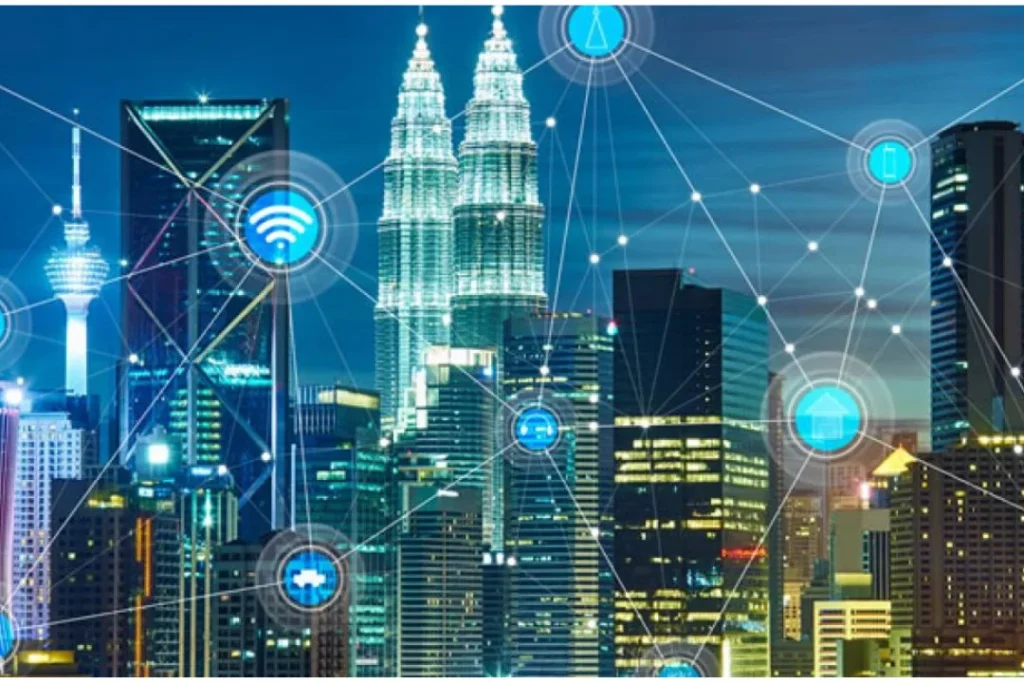
Your morning commute just got 30% shorter, and you did not even notice the difference. Traffic lights are now changing according to the actual conditions of the road in real time. Energy expenses in your city fell by a quarter last year. Emergency services arrived 40% faster than they did five years ago. This improvement doesn’t look to some distant future. This shift is happening now in cities across North America.
The transformation is huge, yet it is invisible. In 2030, the number of connected and communicating devices will increase to 40 billion. These aren’t just gadgets; they’re the building blocks of a whole new urban infrastructure that is smarter, more efficient, and better geared towards the needs of people that live in these cities.
Understanding the Smart City Foundation
Think of the smart city as some sort of nervous system of urban areas. Cities can now monitor everything at all times and respond before issues become too large, rather than waiting for scheduled maintenance or for problems to be seen or reported. To do so, the technology stack has three critical layers working in concert with each other.
First there’s the infrastructure of the 5G network that finally delivers on the promise of instant communication. In milliseconds instead of seconds, a self-driving vehicle can now process and respond to changing road conditions, making a significant difference in preventing accidents. Second, edge computing has brought the processing closer to the extent of data itself. Your smart home system doesn’t have to spin up a ping to a server that may be halfway across the country and wait to make decisions; it makes decisions locally and instantly. Third, artificial intelligence has grown from being merely a tool of automation to actually being a system of learning that improves at its job over time.
When you have all these three technologies working together, you have something that is amazingly powerful. Manufacturing facilities use this combination to forecast failures in equipment weeks ahead, allowing them to schedule maintenance during periods of planned downtime instead of having to deal with costly emergency repairs. Healthcare providers are able to monitor dozens of vital signs around the clock by wearing wearable devices, detecting worrying trends that can be turned into medical emergencies.
How Cities Are Using Connected Technology Today
The economic effects of traffic congestion in the United States are over $120 billion in lost productivity and wasted fuel a year. Smart traffic management systems are addressing this issue directly by sending flow patterns throughout entire metropolitan areas and dynamically changing the timing of signals. When a major accident occurs, the system automatically reroutes traffic to avoid the ripple effect, which would otherwise spread congestion for miles.
Energy consumption poses a significant challenge in urban areas. Traditional power grids evaporate enormous amounts of electricity just because they can’t balance the supply and demand of electricity in real-time. Smart grids make instantaneous adjustments in vast distribution networks using interconnected sensors. During peak periods of usage, the system can use reduced power for non-essential systems or draw from battery stores to avoid system overloads. Cities that have properly implemented these systems are experiencing energy costs reduced by 20 to 30 percent.
Connected surveillance and emergency response systems have helped to revolutionize public safety. Networked cameras can be used to track suspects at various intersections after a crime, and emergency services can receive instant information with the exact location and relevant information. Cities with well-implemented systems have cut response times radically, which in many cases makes the difference in critical situations.
Environmental monitoring is now becoming important as cities strive toward climate goals. Sensor networks monitor air quality and water purity and rates of pollution in urban areas. When readings go beyond safe levels, the system sends automatic alerts to the concerned agencies. This is a data-driven approach that is helping cities achieve emission reductions of 15 to 25 percent.
| Smart City Application | Primary Benefit | Measured Impact |
| Intelligent Traffic Management | Reduced congestion | 25-35% less travel time |
| Smart Energy Grids | Optimized distribution | 20-30% lower costs |
| Connected Public Safety | Faster response times | 40% quicker emergency response |
| Environmental Monitoring | Data-driven decisions | 15-25% emission reduction |
The Security Challenge Nobody Wants to Talk About
The bad news is that every single connected device represents a potential point of control for attackers. The same thing that makes these systems good is also what makes them bad. The numbers are alarming. Connected devices are hacked by an average of 820,000 attempts each and every day, a 46% rise from the past year. Over half of all connected equipment has at least one critical vulnerability, which may be exploited.
The issue usually begins with the design and deployment of devices. Many machines still come with default passwords such as “admin,” for example, or “password.” Automated attack scripts are always scanning the internet for devices with these predictable credentials. Once the attackers gain access to one device, they use it as a stepping stone to obtain access to more valuable systems on the same network.
Outdated firmware is the reason for a huge percentage of successful breaches. Research shows that 60% of successful attacks exploit known vulnerabilities that have patches available, but the patches were never applied. The challenge lies in the fact that updating thousands or millions of distributed devices is extremely difficult. Some of these devices go for years without receiving a single security update.
Network design serves to increase these device-level problems. Studies have shown that 77% of networks have no proper segmentation, which means that connected devices can interact directly with critical business systems. A hacker who gains access to a smart thermostat or surveillance camera should not be able to move laterally through the network to access financial databases or customer data; however, network architecture often facilitates this type of movement.
The healthcare sector is particularly vulnerable because it relies on outdated operating systems that cannot be easily patched, largely due to the presence of obsolete medical devices. The average cost of a healthcare data breach is now more than $10 million. Manufacturing—there has been a 46% rise in ransomware attacks affecting operational technology.
Building Security Into Connected Systems
Protection requires a layered approach, which would tackle vulnerabilities on multiple levels. Network segmentation serves as the basis. VLANs and firewalls are also necessary to position connected devices in a way that prevents them from being too close to critical business systems. This ensures that even if a hacker manages to breach a device, they will encounter a barrier when attempting to penetrate deeper into the network. Companies that have proper segmentation have saved 35% on breach costs.
Authentication and access control have to be strong from the beginning. Each device maintains unique credentials, never sharing them across multiple units. Multi-factor authentication must be used wherever possible. The principle of least privilege is applicable here too. Devices should only access network resources that they absolutely need in order to function, nothing more.
Encryption is used to protect data at rest and in transit. All communication needs to be done with modern protocols such as TLS 1.3, and information stored on devices needs to be encrypted by strong algorithms, so that physical stolen data doesn’t automatically mean compromised data.
Continuous monitoring is now the key to detecting the threats early. Modern security platforms make use of machine learning to set up baseline behaviors for devices and networks. The system alerts when there are unusual data transfers, connections, or usage patterns. The most advanced platforms are even able to respond automatically and isolate compromised devices before they can spread malware or steal data.
Zero trust architecture is a fundamental shift in the way that we think about network security. The traditional model has assumed that everything inside the network perimeter could be trusted. Zero trust assumes that every connection might be compromised, and it must be verified at all times. This strategy is especially well-suited in the context of connected device environments that have poor perimeter definitions and devices that are distributed across a wide area.
The Industrial Connection
The relationship between smart cities and industrial applications goes much deeper than most people are aware. Manufacturing plants are adopting the same basic technologies that are driving smart city infrastructure. Predictive maintenance systems—in factories, sensors are used to monitor the vibration, temperature, and power consumption of equipment, and machine learning is then used to pick up on patterns that suggest pending failures. Companies using this approach have been able to reduce their maintenance cost by 35% as well as reduce unexpected downtime by 60%.
Supply chain visibility has improved tremendously through asset tracking systems using the technology of the radiofrequency identification (RFID) tag and the global positioning system (GPS) sensor. This same technology is helping to optimize urban logistics, as it lowers the delivery time and reduces the impact of transportation on the environment. The combination of smart factories and smart cities creates opportunities for comprehensive solutions that benefit both industrial operations and urban infrastructure.
Making It Happen: A Practical Roadmap
Cities and businesses coming to smart infrastructure need to begin with pilot projects and not try to do everything all at once. Successful organizations are those that started small, learned during the implementation of their initial projects, and then scaled up while developing their expertise. They also invested in the infrastructure, skills, and processes they need to maintain and secure connected systems over the long term.
Sustainability has become a key factor when developing connected technologies. Billions of devices are a large source of energy use, but new designs for ultra-low-power devices mean that it’s possible to keep them running for years at a time using small batteries, or even by harvesting energy from their environment. Connected systems also protect efficient use of resources across industries, ranging from optimizing irrigation of fields in agriculture to reducing waste in industries.
The market for smart city technology has exploded to almost $1.8 trillion with proven results and rising demands for efficient urban infrastructure. Cities that invest in these systems aren’t just chasing the latest technology trend; they’re stopping real problems that cost billions in wasted resources, lost productivity, and diminished quality of life.
The Road Ahead
The connected device revolution is not some future thing that is waiting to happen. The connected device revolution is currently unfolding, transforming industries and presenting both opportunities and challenges that require immediate attention. The technology has matured to the point where the question is no longer whether to implement it, but how to do so effectively and securely.
The future ahead is deciding between innovation and prudence, ambition and security, and possibilities and practicality. Cities and businesses that are rushing to implement connected systems without adequate planning and security cause more problems than they solve. Those who completely ignore these developments, on the other hand, are losing the opportunity to make things more efficient, cost-effective, and capable of better service. The smart approach is somewhere in between: smart implementation, with comprehensive security, driven by clear objectives, and measured by real results.