
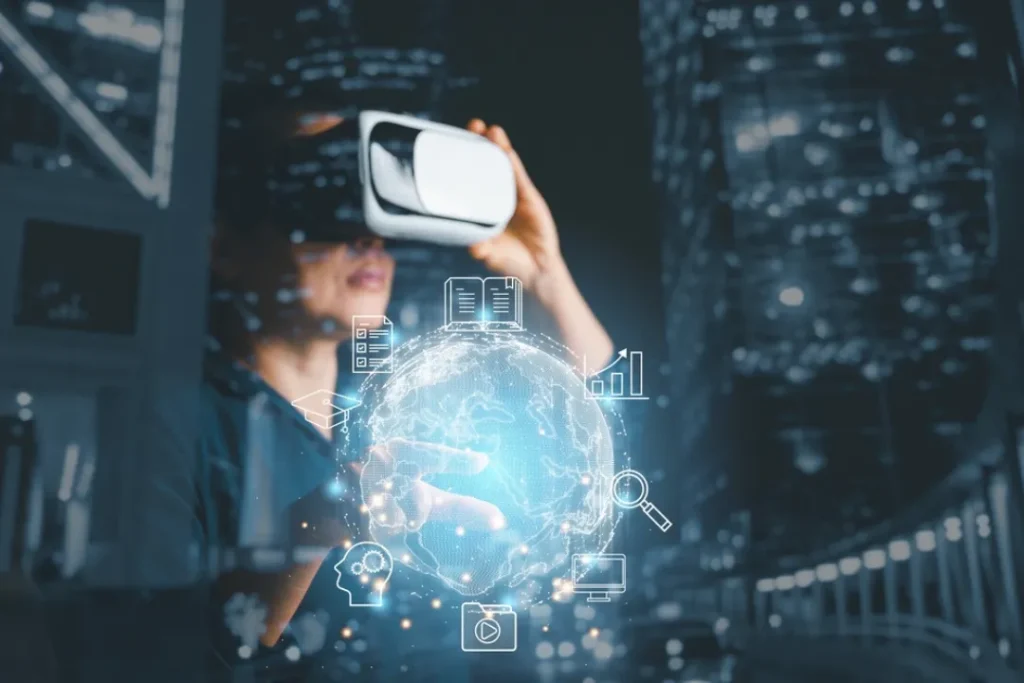
Virtual Reality (VR) is quickly gaining a place of honor in the field of modern education and professional training, as an immersive, interactive, and highly effective method of learning. In the year 2025, the VR is no longer the future; it is the practical reality that is changing classrooms, corporate training programs and specialized skill development. This article investigates the nature of the impact that VR will have on both education and professional training ranging from its benefits and real-world applications to its potential for the future.
The Evolution of VR in Education
From Theory to Practice
The use of VR in education has moved from the world of theories to implementation. When VR first came out, the idea of it used as a tool for entertainment and gaming purposes, but it quickly became clear how it can be used in educational fields. Educational institutions were one of the first institutions to realise VR’s potential to move students beyond the pages of textbooks and traditional educational methods.
Today, VR is being used in schools, universities and online learning platforms to deliver immersive learning experiences to students that were previously impossible. The technology has reached a stage of maturity where it’s no longer cost prohibitive for educational institutions to afford and there is now a massive amount of educational VR content available. From grade school kids to graduate programs, educators are finding creative ways to integrate VR into their curriculum.
Immersive Learning Experiences
VR can allow students to take a virtual walk in real environments that model real-world situations with unbelievable fidelity. History students can visit ancient civilizations, stroll down the streets of Rome during its heyday or watch history happen before them. Biology students can perform virtual dissections with an amount of precision and detail not possible in the traditional lab setting, looking at organs and systems at different scales. Geography students can fly far and wide without ever leaving the classroom, everything from the ocean to the mountaintop, from ecosystems to geological formations can be experienced first hand.
These immersive experiences make learning more engaging and memorable, and they can help students to better understand complex concepts. The experiential nature of VR learning produces stronger neural pathways than with passive learning methods resulting in better comprehension and recall. Students aren’t simply doing the dry reading about concepts, they’re experiencing them – and that fundamentally alters the way knowledge is absorbed and retained.
Accessibility and Inclusivity
VR technology is increasingly more accessible, which means that a larger population of students can have access to immersive learning experiences. This inclusivity is important particularly to students with disabilities, who may not be able to participate in traditional hands-on activities. A student with mobility limitations can experience environments that may not be physically accessible and a student with sensory processing differences can learn in controlled and customizable virtual settings that have their needs met.
VR has the potential to offer alternative mechanisms through which these students can interact with educational content and become educated on important skills. For students on the autism spectrum, VR provides situations in which to practice social interactions in safe, repeatable scenarios. For individuals who are visually impaired, audio enhanced VR experiences can offer rich experiences to learn from. This democratisation of educational experiences is a critical way of ensuring access to high quality and engaging learning experiences for all students, regardless of their physical limitations.
VR in Professional Training
Real-World Simulations
Professional training is another area that VR is making a big impact in. VR can be used to give trainees the chance to practice skills in a safe and controlled environment, in a way that simulates real-world scenarios and without the risks associated with real-life practice. The capacity to fail without major consequences and learn something is an invaluable ability, especially in high-stakes professions.
Medical students are able to practice surgeries in VR environments, performing the procedures again and again until muscle memory has been developed and confidence has been built. They may have rare medical emergencies that they may not encounter in traditional training. Pilots can use VR simulators to practice flight maneuvers and emergency procedures, without the risk of life and death. engine failures, extreme weather, and system malfunctions. Emergency response workers can train for disaster scenarios ranging from building collapses to hazardous material spills in preparation for situations they hope never to be prepared for on the real world.
Enhanced Engagement and Retention
VR training is so interesting; it can attract the best attention of the trainees and make learning a more enjoyable process for them. Unlike the old-school training techniques that can be dull, VR makes the experience memorable and the participants actively involved, unlike the passive observers. The immersive nature of VR makes it possible for trainees to remember information better and develop practical skills thanks to the form of experiential learning.
Studies have found that the retention rate of information is up to 75%, compared to the 10% for traditional lecture-based learning programs, with VR training. Trainees show better performance and report better confidence after taking part in VR training sessions. The ability to practice procedures several times in succession, while getting immediate feedback on how well one is performing that procedure, accelerates skill development vastly.
Cost-Effective and Scalable
VR training is also cost-effective and scalable on the long-term. Once a VR training programme is developed, it can be used time and time again with relatively little additional cost. While the initial investment in VR hardware and development of contents could be significant, the ROI of your investment becomes apparent when you compare it to traditional training methods that involve physical materials, specialized facilities as well as expert instructors for each session.
This makes VR training a practical solution for organisations that have a large number of employees or trainees. Additionally, VR training can be accessed remotely, which can help trainees learn at their own pace and on their own schedule. This flexibility makes logistical issues less of a problem, and makes consistent training quality possible across geographically dispersed training teams.
Real-World Applications Across Industries
Medical Education and Training
VR is changing how medicine is taught and trained because of the realistic simulations of surgical procedures and patient care. Medical students can perform complicated surgeries in VR spaces where they gain practical experience without the risks of performing surgeries. They can do the same thing dozens of times, and perfect their technique and gain confidence in doing it.
VR also allows medical students to experience rare conditions and procedures that they might not be able to experience during their traditional medical rotations. Anatomy lessons come alive as students are able to explore the human body like never before; in three dimensions. lesson students can explore organs, tissues and systems from any angle. This not only helps in improving their skills but also helps grow their confidence and readiness to apply them in real-life scenarios, which ultimately will result in better treatment of patients in the long run.
Aviation and Aerospace
In the fields of aviation and aerospace industries, VR helps in training pilots and engineers with unprecedented level of realism. VR simulators can let pilots practice flight maneuvers and emergency procedures and learn navigation in a safe and controlled manner that mimics the experience of sitting in the cockpit with incredible accuracy. They can experience weather conditions, mechanical failures and difficult landing situations without ever hitting the ground.
Engineers can utilise VR to design and test aircraft components in the virtual world, walking through full-scale aircraft interiors and find design issues before even physical prototypes are built. This results in fewer expensive physical prototypes and because it speeds up the development process, millions in development costs can be saved as well as increasing safety and efficiency.
Manufacturing and Industrial Training
In the manufacturing and industrial sectors, VR is being extensively used to simulate the operation of complex machinery and equipment because of its benefits. Workers can get practise using dangerous machinery in a virtual world, making mistakes and learning from them without the risk of injury to themselves or damage to equipment. They can experience emergency shutdowns, equipment malfunctions, and safety procedures over and over again until the responses are automatic.
VR training has also been used to make simulations of dangerous settings so that workers can go through safety procedures and emergency responses in scenarios that involve toxic chemicals, extreme temperatures, or enclosed spaces. This creates a work environment where workers are ready for potential dangers while remaining safe during work training, and this can drastically reduce workplace accidents.
Emergency Response and Public Safety
Emergency responders and public safety personnel are using VR in order to practice disaster preparation and emergency situations to a level of reality that had never been possible before. VR simulations can be used to train trainees on how to respond to fires, earthquakes, active shooter situations, and other emergencies in a safe and controlled environment. They are able to experience the stress, chaos, and challenges of making decisions in real emergencies, without any real danger.
This helps them to gain the skills, confidence and psychological preparedness to cope effectively when faced with real-world situations. Teams can practice coordination and communicating under pressure and identify weaknesses in protocols and improve response strategies.
Corporate Training and Soft Skills
VR is going to be used for corporate training, as well, as a tool for building soft skills such as leadership, communication, and teamwork. VR simulations give your employees a chance to practise these skills in realistic scenarios ranging from challenging conversations with employees to high-pressure presentations. They get instant feedback with body language, tone, and decision making, which helps them to better their performance.
This is especially helpful for training managers and leaders, who require a wide range of interpersonal skills to be effective in their roles. VR gives them the ability to experience difficult work situations – such as conflict resolution or communicating bad news – in a safe environment in which they can learn from their mistakes without real-world consequences.
Benefits of VR in Education and Training
The benefits of VR in education and training lie in a number of ways, and this has been well documented. Increased engagement helps to capture learner’s attention better than the traditional methods, where the novelty and immersion of VR helps to create memorable experiences. Improved retention rates with learners retaining more of what they’ve learnt – studies have found there are significant advantages over traditional instruction.
The ability to train skills in a safe and controlled environment afforded by VR means that learners can practice skills without real-world risks and is therefore ideal for high-stakes professions. The cost-effectiveness and scalability of VR training are sorely evident over time because programmes can be re-used endlessly. The benefits in terms of accessibility and inclusivity make sure more learners can benefit from high-quality training regardless of physical limitations and geographical location.
Future Trends and Potential
As the power and capabilities of VR technology have been continually advancing, we can only expect even more advanced and realistic simulations in the future. Improvements in haptic feedback will give users the ability to feel virtual objects while higher resolution displays will remove the screen-door effect all together. The combination of AI and machine learning with VR will help create personalised learning experiences that are tailored to the needs, pace, and learning styles of individual learners.
As VR technology becomes more accessible and affordable, we can expect to see more and more applications in education and training. VR will be applied in more industries and for more things, from technical and vocational training to developing soft skills. The distinction between the physical and virtual education will continue to blur with hybrid approaches becoming the norm.
Conclusion
Virtual Reality is changing the face of education and professional training, and it is now providing a new, immersive, interactive, and highly effective learning experience. The advantages of VR such as engagement, retention, and safe and controlled environment make it a useful tool for educators and trainers. As the VR technology continues to innovate and grow, there will be more applications for the technology in education and training, allowing for new opportunities of innovation and growth. The future of education and training is here and VR is at the forefront of it.
Frequently Asked Questions
How much does VR training equipment cost?
VR headset prices start with $300 and go all the way up to $1,000+ for the excellent headsets. Educational institutions tend to get discounts by volume. While initial investment can be significant, using content to teach software developers results in a dramatic reduction in the cost of training, as content can be used over and over again.
Is VR training as effective as real-world practice?
Research shows VR training is as effective or more effective than the traditional method for a number of different skills. And, as with all things, while it shouldn’t out and out replace hands on practice in all fields, VR offers safe repetition and exposure to rare scenarios which would be difficult to recreate in real life.
Can VR cause motion sickness in students?
Some users experience VR motion sickness, although modern headsets as well as the improvement of software has reduced this considerably. Sessions can be made to be short at first when the user is building tolerance. Most people get used to it very quickly, and the newer the technology, the more this problem is minimised.
What age is appropriate for VR in education?
Most manufacturers have eye development concerns which suggest VR use for aged 13 and older. However, shorter periods of supervision may be suitable for smaller students. Educational institutes need to look up the guidelines and use age-appropriate content and session durations.
Do teachers need special training to use VR?
While the basic use of VR is intuitive, it does pay for teachers to be trained on educational applications, how to choose content, how to manage the classroom with VR technology and troubleshooting. Many VR education platforms have teacher resources and professional development programs.
Can VR training replace traditional instructors?
VR is a great tool, but it would probably best work in conjunction with the instructor guiding the learners. Teachers and trainers give context, facilitate discussions, evaluate understanding, and tailor according to the needs of individuals, things that VR cannot do. The best approach is the combination of VR and traditional instruction.
How do you measure learning outcomes in VR training?
VR platforms can be used to track things like completion rates, time spent on tasks, decision making and accuracy of performance. Combined with traditional assessments, in conjunction with practical demonstrations, this is comprehensive evaluation of learning outcomes.
What industries benefit most from VR training?
Healthcare, aviation, manufacturing, emergency, military, construction, and corporate training greatly benefit. Any field that requires hands-on skills practise, safety training or access to rare/dangerous scenarios can benefit from VR training.